
Configure OCI system
To set up the system, you must go to the detailed settings. To do this, you must click on ‘Technical name’ on the overview page.

You are now on the first page of the system (‘General’ tab). Here you can configure the general data of the system, the system licence key and the login parameters. To edit the data, you must first click the ‘Edit’ button at the top right. The fields can then be edited.

Auf dieser Seite:
1. Tab "General"
General informationen

| Feldname | Beschreibung |
|---|---|
| Technical name | The technical name must be unique. Relevant for technical things. |
| Name | Name to identify the system in the overview. |
| OCI version | Here you can choose between OCI version 4.0 and 5.0. |
| Standard unit | Serves as a final fallback if no unit of measurement has been specified for the items, but the customer system requires a unit of measurement. |
| Index start | The transfer of the products in the transfer starts with the specified number (1 → position 1). From experience, we recommend starting with 1 at this point, unless you receive other information from your customer. |
| Active | Indicates whether the system is active. When creating a new system, the value is set to inactive by default. |
| Attach shipping | Specifies whether the dispatch after all items should be transferred to the customer system as an extra item (fields for this can be configured separately). |
License
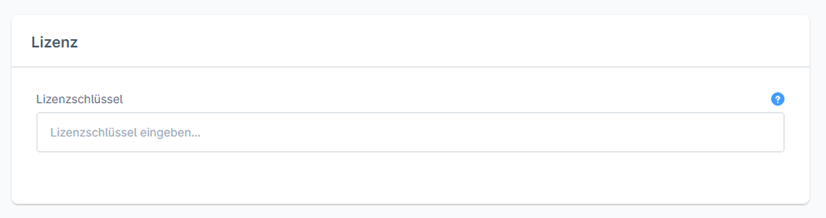
You can find further information on depositing a system licence for your OCI system at Assign OCI licenses.
Login

| Feldname | Beschreibung |
|---|---|
| Variable user name | Name of the parameter User name in the customer system (login parameter; customisable). Do not enter the customer user. |
| Variable password | Name of the parameter Password in the customer system (login parameter; customisable). Do not enter the customer password. |
| Variable URL | Name of the parameter for the hook URL in the customer system (login parameter; customisable) |
| Variable token | Designation of the Token parameter in the customer system (login parameter; customisable). The token does not have to be configured / used, it is just an alternative authentication option. ➔ The token is intended for when the customer system only uses a token instead of a user name and password. |
| User-defined token field | The name of an additional field on the customer can be specified here, from which the value for the token is then drawn. |
| Validate URL | If activated, the hook URL is validated. Our recommendation is that this option should be activated unless you receive other information from your customer. |
| Guest session | If this option is activated, a guest session is always created for each individual punchout from the customer system instead of the normal Shopware customer. With a guest session (i.e. activated option), a complete copy of the assigned customer account is always created. Background: By default, if two different PCs log in with the same customer account, the shopping basket must be shared. This means that if something is placed in the shopping basket on one PC, the person who is logged in on the other PC will also receive this item in the shopping basket. Therefore, our recommendation is that this option should remain activated unless there are reasons to deactivate it (e.g. price calculation does not work otherwise or similar). |
Notes:
Value for the user name: Currently, only the e-mail address of the assigned Shopware customer is possible at this point. We are working on a setting option so that the Shopware customer number can also be used.
Value for the password: The password of the Shopware customer account is always used here. This cannot be configured either.
Value for the hook URL: Is normally provided automatically from the customer system.
Examples for setting the variables: Usage user name, password:

A URL would then look like this, for example: ➔ The curly brackets contain data or examples that must then be replaced, just as your shop domain must be specified at the front https://mein-shop.de/AgiqonOciEntry/login?USERNAME={customer email}&PASSWORD={customer password}&HOOK_URL={https://www.test.de} Example with token:

A URL would then look like this, for example:
➔ The curly brackets contain data or examples that must then be replaced, just as your shop domain must be specified at the front
https://mein-shop.de/AgiqonOciEntry/login?TOKEN={Token_additional_field}& HOOK_URL={https://www.test.de}
2. Tab "Customer"

You can find further information on depositing a system licence for your OCI system at Add OCI license.
3. Tab "Product fields"
The fields that are transferred to the customer system with the products in the shopping basket can be configured here. An overview of all the fields created is displayed here.

To add new fields or customise existing ones, you must first click on the ‘Edit’ button at the top right. You can then either add another field using the ‘New field’ button or edit a field using the three dots behind an entry in the list.

The view does not differ when editing or creating a new field.

| Field name | Description |
|---|---|
| Type | Specifies whether the field is a normal field or a long text. Possible values: ➔ standard ➔ long |
| Name | Name of the field in the transfer (possible fields can be found in the OCI documentation Link to the OCI defaul documentation) |
| Position | Specifies the position within the transmission. |
| Shopware field | Here you can define which value should be transferred from a shopping cart / product field from Shopware to the customer system. A list of the fields can be found below. If a static default value is to be transmitted, leave the field empty and enter something under “Default value”. |
| Shopware field fallback 1 | A fallback value for the “Shopware field” field can be entered here. This value is used if the field is empty or does not exist. If a static default value is to be transmitted, leave the field empty and enter something under “Default value”. If no further fallback is required, simply leave it empty. |
| Shopware field fallback 2 |
Fallback for fallback 1 If a static default value is to be transmitted, leave the field empty and enter something under “Default value”. If no further fallback is required, simply leave it empty. |
| Shopware field fallback 3 |
Fallback for fallback 2 If a static default value is to be transmitted, leave the field empty and enter something under “Default value”. If no further fallback is required, simply leave it empty. |
| Standard value | A static value can be entered here, which then applies to all transferred products. Can be used as a fallback and as a basic standard. If no further fallback is required, simply leave empty. |
| Character limit | If activated, a character limit can be specified here. In the first field, you can specify the character from which it should start. In the second field, enter the character after which everything should be cut off. |
| Display decimal places | If activated, the number of decimal places can be defined here (for number fields). |
| Divide by | The field value is divided by the value entered in the “Divisor” field. For example: The field value is “5” and the divisor is “10”, then the value “0.5” is displayed. |
Selection value for 'Shopware field'
| Field name | Description |
|---|---|
| Total product price | Total price of the item in the shopping cart (quantity × unit price) |
| Unit product price | Unit price of the item |
| Product quantity | Quantity of the position |
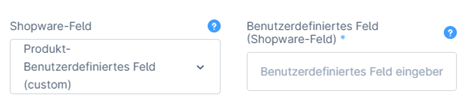
| Product - user-defined field (custom) | Any additional field you wish can be stored here. To do this, you must enter the technical name of the additional field in the “Custom field (Shopware field)”. The field only appears if the value for the custom is selected at the front. ➔ See screenshot below the table |
| Product - User-defined field (agicon_oci_me_class) | This option takes its value from a field on the product that is created by the plugin. For example, the eClass number can be entered on the product here. |
| Product - User-defined field (agicon_oci_me) | This option takes its value from a field on the product that is created by the plugin. The unit of measurement from the customer system can be entered in this field (e.g. piece = PCE). The field is directly on the product, but there is also an option to store the unit directly on the unit of measurement in the Shopware backend. |
| Product description | Standard Shopware product description (standard language) |
| Product EAN number | Standard Shopware field for EAN |
| Product height | Standard Shopware field for height |
| Produkt ID | Database ID of the article |
| Product length | Standard Shopware field for the length |
| Product manufacturer number | Standard Shopware field for the manufacturer number (on the product) |
| Product name | Shopware product name (standard language) |
| Product packaging unit | Standard Shopware field for the packaging unit |
| Product packaging unit (plural) | Product packaging unit (plural) |
| Product number | Shopware Product number |
| Product unit | Standard Shopware field for the unit |
| Product tax | Tax rate |
| Translated product description | Standard Shopware product description (language of the sales channel) |
| Translated Product name | Shopware product name (language of the sales channel) |
| Product weight | Standard Shopware field for weight |
| Product range | Standard Shopware field for range |
| Manufacturer name | Standard Shopware field for the manufacturer (only name in the standard language) |
| Translated manufacturer name | Standard Shopware field for the manufacturer (only name in the language of the sales channel) |
| OCI system unit extension | Here, the value assigned in the “Units” tab is transferred to the Shopware unit of measurement (if the unit of measurement is maintained for the product). If this is not maintained for the product, for example, the “Standard unit” defined in the “General” tab can be defined as a fallback (or in the field configuration itself). |
| ISO currency code | ISO code of the currency selected in the sales channel (if more than one is available in the store; if only one, then logically the value of the store currency). |
| Standard OCI system unit | 'Default unit' field in the ‘General’ tab |
4. Tab "Shipping fields"
If you do not transfer the shipping costs to the customer system (i.e. the “Attach shipping costs” field in the “General” tab is inactive), you do not need to make any settings here. If you do transfer the shipping costs, you can configure the transferred fields for the item with the shipping costs here. The fields in the field configuration do not differ from those in the product field configuration. Only the selection values for the Shopware field differ here, as the data comes directly from the shipping method (Shopware shipping under “Settings” ➔ “Shipping”).
| Field name | Description |
|---|---|
| Shipping name | Shopware field for the name of the shipping type if nothing is maintained in the 'OCI shipping name' field for the shipping type |
| Internal shipping item number | An 'OCI shipping internal article number' field created by the plugin for the shipping type |
| Shipping number | An 'OCI shipping eNumber' field created by the plugin for the shipping type |
| ISO currency code | ISO code for currency |
| Total shipping costs | Total costs for shipping |
| Shipping tax | Tax rate for shipping costs |
5. Tab "Units"
Under Units, you can store values for the Shopware units of measurement, which are then transferred to the customer system instead of the Shopware units of measurement. Default values can be defined as described above in the field configuration via “Default value” or via the “Default unit” field in the “General” tab.

Units of measurement can be mapped using the “Edit” button and the “New unit” field. Note: Of course, units of measurement must first be created in Shopware (under “Settings” ➔ “Units of measurement”) so that they can be mapped (otherwise use the default unit).

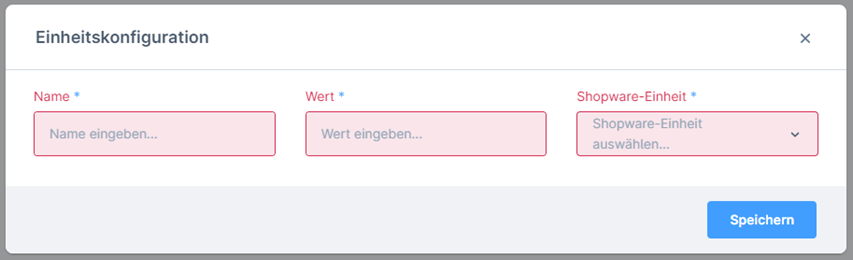
A pop-up will then open in which you can carry out the mapping.
| Feldname | Beschreibung |
|---|---|
| Name | Specification of a name for clarity in the table |
| Value | Specification of the value to be transferred for the unit of measurement |
| Shopware unit | Selection from the existing Shopware units of measurement (mapping) |